
Osoberry
The Pacific Northwest's Early Harbinger of Spring

When I look out into the winter landscape
All is barren except for scattered bright green buds
Catching the filtered early morning light.

Hope brims in my heart to see the return
Of ephemeral dangling clusters of white flowers,
Signaling the start of spring around the forest.

Sometimes these cold winters sink so deep into my bones
I forget that not all days are clouds and rain.
Osoberry reminds me to be brightness on dark midwinter days
And that I can go slow and let others fruit first.
Welcoming Spring …
It’s the first week of February, a month that feels like a pivoting point in the year. February offers peculiar holidays, like Groundhog Day, where we let a plump rodent dictate our hopes for the coming of spring. Even the month itself seems to bow to the rhythms of nature, stretching to accommodate an extra day every four years, as if we’re collectively trying to recalibrate ourselves with the balance of dark and light. Perhaps that’s what we crave most in midwinter: a break from the monotony of chopping wood, huddling by the fire, reading, storytelling, dreaming, and ladling endless bowls of soup. For some, the comfort of winter’s slower pace is enough; for others, it’s a struggle not to hibernate entirely. Yet, as we learn year after year, winter inevitably gives way to spring, no matter how long or short the wait may feel.
This transitional energy is what Imbolc, the ancient Gaelic festival, captures so well. Celebrated on February 1 or 2, Imbolc marks the midpoint between the winter solstice and the spring equinox. Its roots trace back to Ireland and Scotland, yet its themes resonate even in the Pacific Northwest, where our climate somewhat mirrors the British Isles. Both regions share similar latitudes, between 45° and 50°, and that kinship brings familiar seasonal rhythms. Here in Washington, the first hint of spring doesn’t come from a groundhog’s shadow nor Brigid’s fire but from the osoberry (Oemleria cerasiformis). This native shrub sends out its delicate, white-green blossoms long before other plants dare to stir. The osoberry’s arrival feels almost miraculous—a quiet rebellion against the lingering cold, whispering, “Spring is coming.”
If Imbolc happens to dawn warm and sunny here in the Pacific Northwest, folklore suggests we’re in for a late winter. With an early, wet fall last year and a mild winter, the osoberry buds might arrive early, catching the faintest hint of lengthening days. The shrub’s return reminds us that seasons march forward even in uncertainty. Like the osoberry blooms, Imbolc is a time of small but meaningful awakenings—of light creeping back into the dark and the earth beginning to stir. It’s a moment to pause and wonder about what the rest of winter will hold. Will we linger in the cold a little longer, or will the osoberry’s blooms prove prophetic, ushering in an early spring?
Osoberry Identification Guide
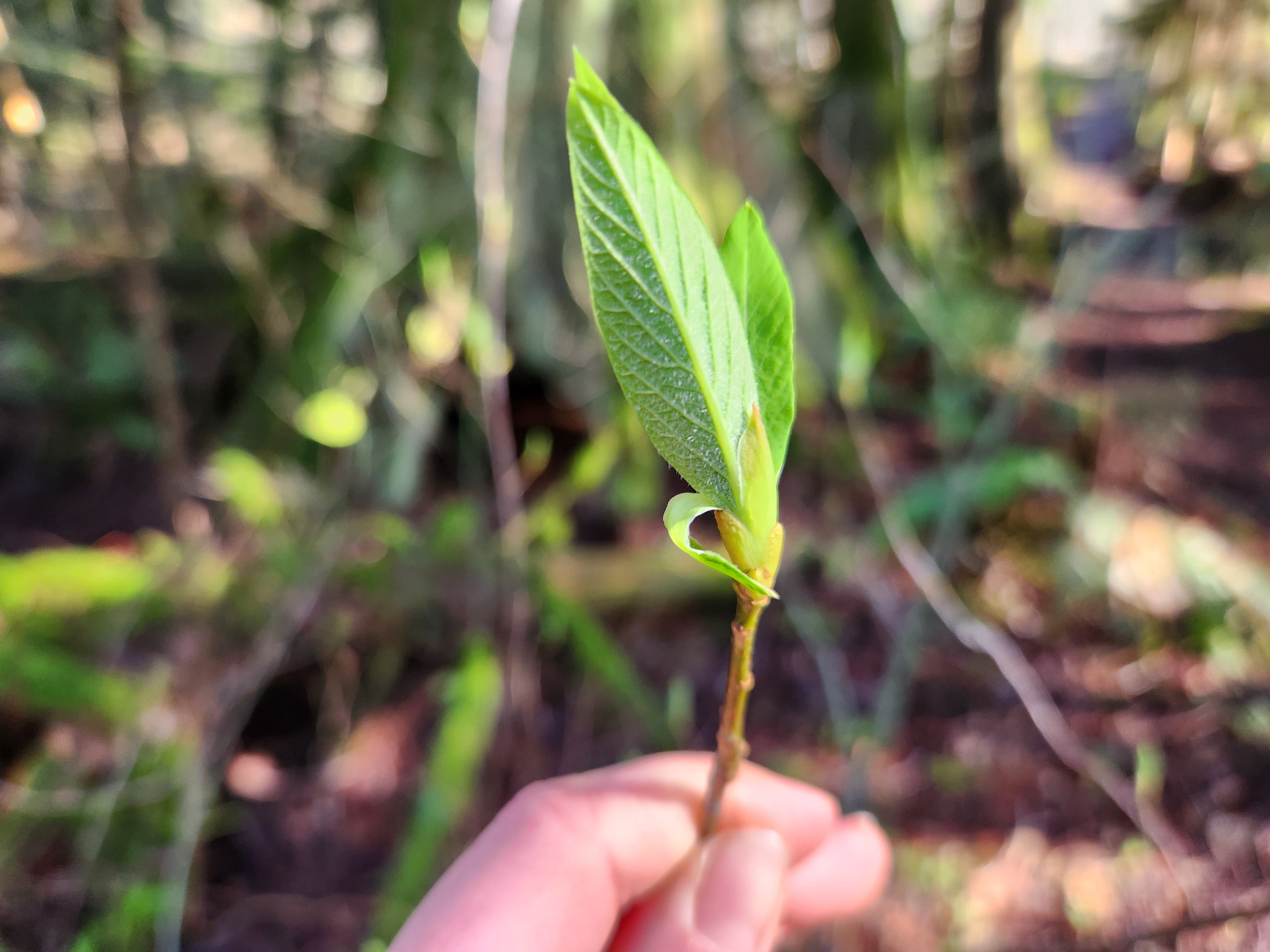
Osoberry (Oemleria cerasiformis) is a deciduous shrub native to the Pacific Northwest. It is also known as “Indian plum” – although I don’t particularly like that name – since the berry has the shape and color of a miniature plum. I note this plant as one of the first native shrubs to bloom in early spring, signaling the end of winter.
Botanical Description:
Family: Rosaceae (Rose family)
Height: Typically grows between 6 to 16 feet (1.8 to 4.9 meters).
Leaves: Alternate, lance-shaped, 2 to 5 inches long, with smooth edges that are slightly rolled under. The leaves are pale green, paler below, and emit a cucumber-like scent when crushed.
Bark and Twigs: Twigs are smooth and purplish-brown with noticeable orange lenticels (pores). The bark has a bitter taste.
Flowers: Fragrant, greenish-white, about ½ inch in size, appearing in loose hanging clusters of 10 to 20 flowers each. Blooming occurs from late winter to early spring, often by late January.
Fruit: The fruit starts out tan to pale orange, transitions through pink to reddish-purple, and ripens to bluish-black with a thin waxy coat. The seed is a stone, or pit, that contains cyanoglucosides.
Habitat and Distribution:
Osoberry is native to the Pacific coast and ranges of North America, from British Columbia, Canada, to Santa Barbara County, California, USA. It thrives in moist open forests, clearings, riparian areas, along roadsides and fence lines, on hillsides, and in canyons. It also occupies drier forests, chaparral, and coastal scrub habitats. The shrub grows on most soil textures but not on saturated or especially shady sites.
Ecological Significance:
Osoberry is a valuable early-season nectar source for pollinators such as bees, moths, butterflies, and hummingbirds. Its fruits are consumed by various small mammals, including foxes, coyotes, deer, bears, and many bird species, aiding in seed dispersal.
Ethnobotanical Uses:
Osoberries were traditionally consumed by several First Nations tribes, including the Cowlitz, Karuk, Kitasoo, Kwakiutl, Lummi, Makah, Nitinaht (Ditidaht), Quinault, Skagit, and Snohomish who consumed the fruits fresh, dried, or cooked, despite their often bitter taste which is reminiscent of cucumber. The bark was used as a tuberculosis remedy and a mild laxative. Strips of bark were also used to bind harpoon tips.
Cultivation and Landscape Use:
Osoberry is popular for restoration projects in the Pacific Northwest due to its ease of propagation, rapid growth, and wide tolerance for various shade and moisture regimes. It is best grown in full sun to part shade in fertile, moist, well-drained soils. In moist soil, plants may sucker extensively. Will tolerate somewhat dryish soils but does not tolerate wet soils. Prune immediately after flowering and remove excess suckers to restrict growth. Established plants may be cut back to near the crown in winter for complete rejuvenation.
Join the chat to share your recent findings and contribute to an ongoing community discussion about foraging in the Pacific Northwest!

What to do with Osoberries
If you like the flavor of cucumber, you might enjoy a little electrolyte and flavor boost by adding fresh osoberry leaves to your water bottle while hiking on the trail.
I might also suggest making a flower essence for springtime since the flavor of the berries is rather – to my tastebuds anyway – unpleasant. I wouldn’t recommend them for syrup or jam because they honestly taste quite bitter despite how much sugar you add.
Osoberry Flower Essence
Use: Flower essences are used in energy work and emotional healing. Osoberry’s early blooming can symbolize resilience and renewal after a harsh winter.
When making your own medicine, other intentions and energies may come up as each plant and person has something to learn from the other, so listen to your intuition when using flower essences.
Instructions:
Find an osoberry growing in the wild or in your garden.
Sit or stand in a position of comfort, ground yourself into your center, and call in any guides or guardians who might be able to assist you with making medicine and building a relationship with this plant.
Introduce yourself to the osoberry, state your intention for visiting and medicine making, then wait.
Note any emotions, colors, memories, scents, etc. that come to your mind.
Harvest fresh osoberry blossoms, place them in a glass bowl of spring water, and let them steep in sunlight (or moonlight depending on your intention) for 3-4 hours.
You may choose to wait with them, sing to them, meditate, or dance while they infuse with the essence of osoberry.
Strain the liquid into a clean jar and preserve it with brandy or vodka (75% spring water to 25% alcohol) to make a mother essence.
Mother essences can be distilled further by adding 3 drops to another container with the 1:4 ratio of water to alcohol.
You can add a drop of glycerin if you enjoy a sweeter flavor.
Use a few drops under the tongue or in water for emotional support.
If you’re not quite up to the task of making your own flower essences, Tree Frog Farm on Lummi Island in Washington makes flower essences from native PNW plants. You can find more information about Osoberry Flower Essences on their website.
For those interested in learning how to make your own flower essences or herbal medicine, join one of our in-person classes in Mount Vernon, WA.
Know someone who would love to get weekly foraging content in their inbox?